



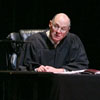
Justice Anthony Kennedy presides over “The Trial of Hamlet”
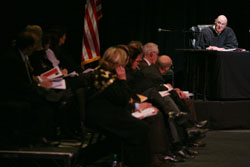
On Monday night, literary history’s most famous melancholic was subject to a modern American trial. Having suffered the slings and arrows of murderous family and disloyal friends, not to mention a poisoning from which he miraculously recovered, Hamlet stoically endured the scrutiny of attorneys and psychiatrists, judge and jury. Together they parsed Hamlet’s soliloquies, speeches and actions to determine whether the young prince was criminally responsible for the murder of Polonius.
Put more colloquially: was Hamlet insane when he stabbed at the arras?
Presented by the Shakespeare Center of Los Angeles, and adjudicated by Supreme Court Justice Anthony M. Kennedy, “The Trial of Hamlet” featured top lawyers, expert witnesses and a jury whose early deliberations were broadcast to the audience. The one-time mock trial event was held in USC’s Bovard Auditorium Jan. 31.
After the bailiff, attired in period costume, called the court to order, Justice Kennedy outlined the proceedings for the benefit of jury and audience.
“The sole purpose of this trial is to determine, at the time Polonius was killed, was Hamlet criminally responsible?” Justice Kennedy said. He offered that Shakespeare’s account of events could be used during the trial.
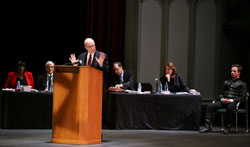
“After 400 years, we are finally getting our day in court,” crowed Blair Berk, a named partner in the firm of Tarlow & Berk, for the defense. “Sane, or not sane, that is the question.”
After reviewing the facts of the case and declaring Hamlet not criminally responsible, Berk called for the defense Dr. Saul J. Faerstein, clinical professor of psychiatry at UCLA.
Drawing lavishly and cleverly on the text of “Hamlet,” Faerstein recalled “the inky blackness” of the prince’s melancholia as an indication of a major depressive episode, and he leaned heavily on the “command hallucination” Hamlet experienced in the form of his slain father’s ghost, who exhorts his son to revenge.
Both the defense and prosecution granted that ghost sightings were more common several hundred years ago and therefore not a sufficient indication of madness.
Danette Myers, past president of the L.A. Bar Association and a 24-year veteran of the L.A. District Attorney’s office, detailed the rationality of Hamlet’s actions leading up to Polonius’s death, particularly the prince’s decision not to murder his uncle, the king, when Hamlet found him praying.
“These are the words of a very thoughtful individual,” she said, adding that Hamlet feigns insanity throughout the play.
“Acting crazy doesn’t make you crazy,” she said.
Dr. Ronald Markman, holder of a law degree and a psychiatrist on staff at Cedars-Sinai Medical Center and the UCLA School of Medicine, was called for the prosecution.
Much of the testimony and cross-examination parsed the definition of insanity as described in the Diagnostic and Statistical Manual of Mental Disorders – referred to throughout the evening as the “Danish Statistical Manual.” The attorneys for both sides, and especially the psychiatrists, displayed a formidable recall of the play, heavily quoting from it to buttress their arguments.
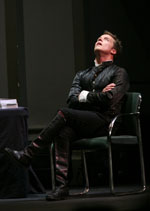
Meanwhile, the title character of what is arguably the greatest play ever written, the man whose soliloquies include some of the most famous lines in all of literature, remained silent throughout the proceedings. Played by Graham Hamilton, Hamlet was not only the sole participant dressed in period costume, but also the only character. At the outset, his placid expression and noble carriage comprised the 800-pound gorilla in the room: when would Hamlet, whose fate was in the balance, join the proceedings?
But as the second half of the trial unfolded, the figure of Hamlet became more diminutive, almost unnoticeable. Although the Dane forever will occupy his role as one of the most compelling characters in all literature, this was a night for lawyers.
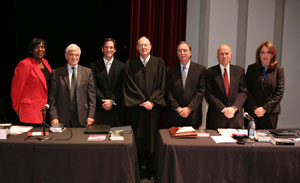
And the verdict? Ten jurors found Hamlet criminally responsible, or sane, with two jurors finding him not criminally responsible. Justice Kennedy thanked the jurors, lawyers and witnesses before remanding Hamlet to the further conjecture of actors, scholars, readers, lawyers and psychiatrists for generations to come.
Photos ©Ryan Miller/Capture Imaging


 Previous Article